Built for the $10M account.
How we helped Adrata distill the essence of its identity.
Every so often, you get the rare privilege of working with a company like Adrata.
Its founder, Ross, had already built and sold a company, then spent six years leading product inside larger software companies. He knew the problem he wanted to solve because he had lived it. That experience became Adrata: an AI product for enterprise sellers working large, complicated deals. It helps reps understand the people, relationships, and changes inside an account so they can decide what to do next.
But when we first met, Adrata was still hard to explain. The product had so many good ideas, but they did not yet add up to one clear story or one coherent experience. Ross felt that something was missing from both. I felt we could change that.
Unmistakable
One of our beliefs at Iceberg is that great products are not just great, but also different—and that means building a product that is unmistakable. That starts with strategy: a clear picture of the landscape and a choice about where the product can be one of a kind. Before we could design Adrata, we needed to understand where it belonged.
We looked at the market across several dimensions. As we began to have a better understanding of the landscape, one axis emerged as essential: deal size. Peter Thiel’s distribution spectrum in Zero to One gave us a way to map it. As we placed each product along the spectrum, the pattern became clear: most tools had been designed for volume—more leads, more accounts, more outreach, more activity. In other words, they all lived in the world of marketing and high-volume, transactional selling.
Adrata was different. Its strongest ideas only mattered when a rep was working a small number of large, complicated deals.
We had finally found our aha moment: Adrata is not built for anyone selling something under $10K.
“This was the unlock that has made every single conversation more clear.”
Below that point, a rep usually does not need to map a large buying committee, follow changes across a complex organization, or work a deal for months. Those problems show up when the stakes—and the number of people involved—get much bigger.
The line was intentionally sharp. It told us who Adrata was for, but just as importantly, who it was not for. A useful strategy does not just describe the future. It helps you say no.
One account
During a workshop, Ross asked a question that made the product click:
“What if Adrata were designed for a rep who had just a single $10M account?”
If your entire year depended on winning one account, you would not care about finding another thousand leads. You would want to know everything about the deal in front of you: who has influence, who can block it, where the warm paths are, what changed this week, and what the rep should do next.
That became the standard for the product: help the rep become the most prepared person in the room.
“We’re gonna be the AI that helps you win the $10M deal.”
Essentialism
Once we had the right customer and the right use case, product decisions became much easier.
Sequences, mass outbound, and dashboards full of activity did not belong. A rep working one major account does not need more noise. They need better information about the people, relationships, and events that could change the outcome.
Adrata would go deep on a few active pursuits instead of going shallow across thousands of leads. The value was no longer “time saved.” It was a better chance of winning the deal.
This is the heart of the work for us: find the idea that is essential, then remove what does not serve it. The result is not a smaller ambition. It is a more concentrated one.
Insanely simple
The hard part was making a product with that much information feel calm and obvious.
The system might need to understand a large organization, dozens of stakeholders, and a constant stream of signals. Most of that complexity can stay below the surface. The rep should not have to feel its weight.
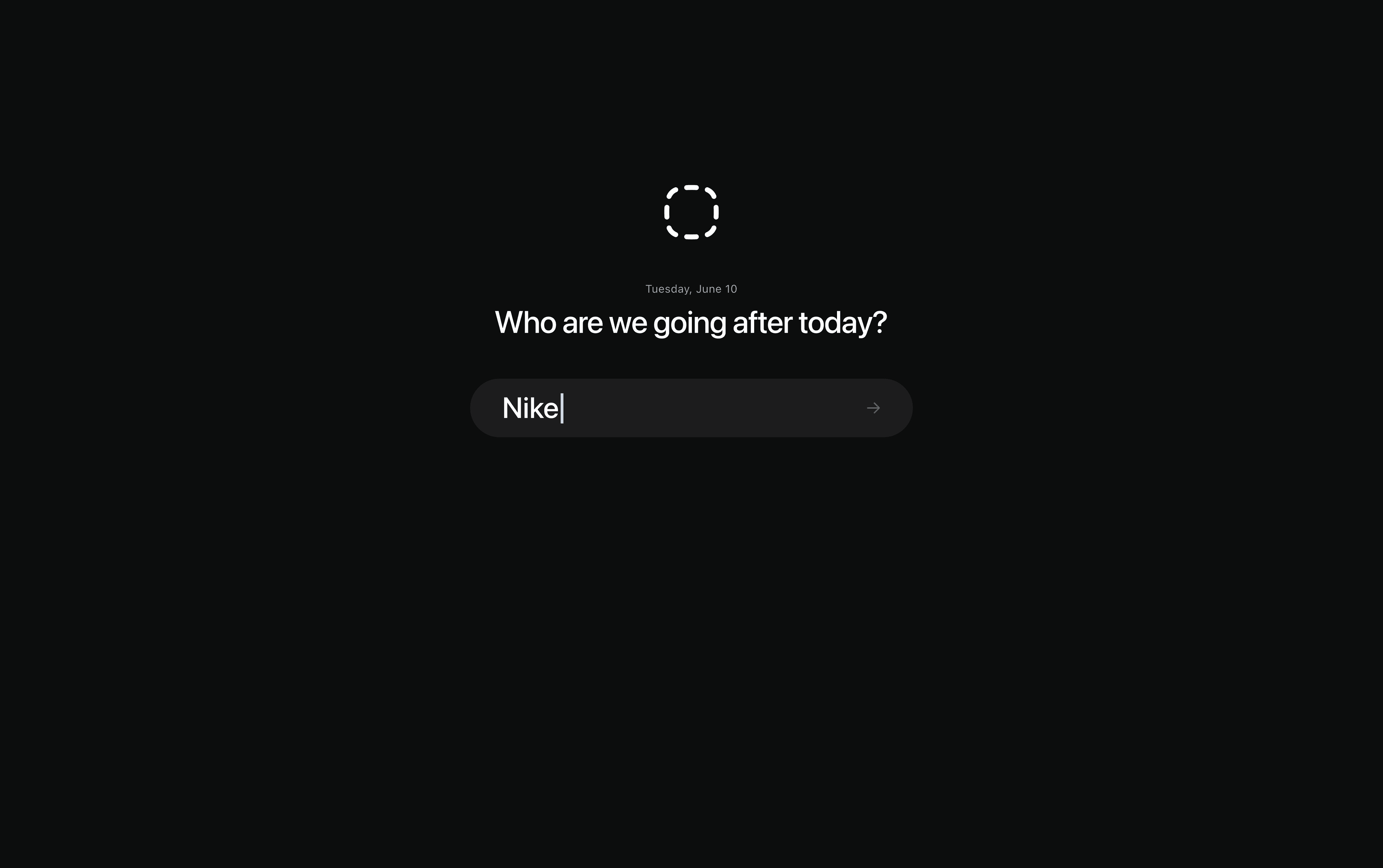
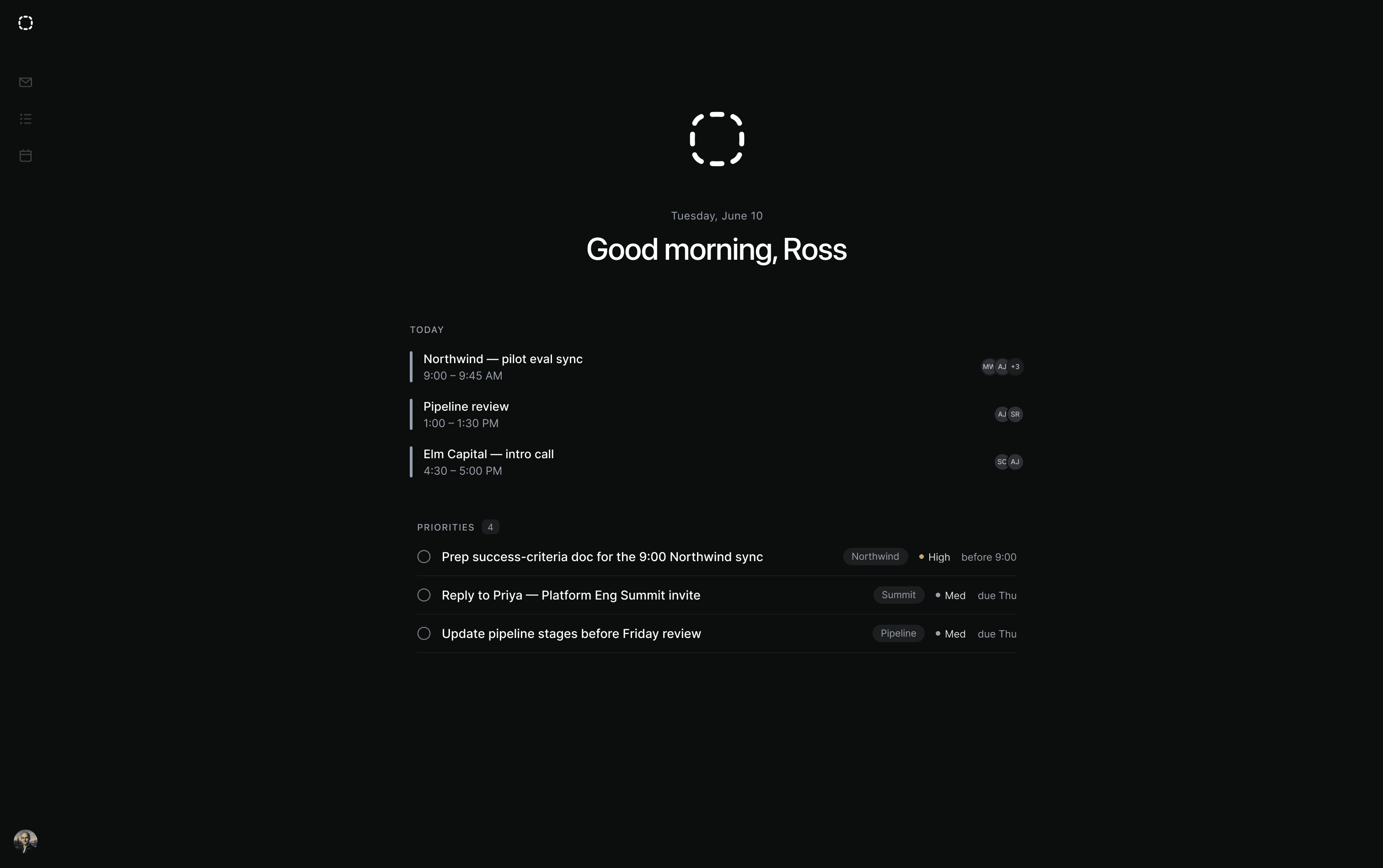
So we kept taking things away. We simplified the screens, reduced visual noise, and focused the first moments of the product on one question: Who are we going after today?
A product built for the $10M deal could not feel like software for a $20-a-month subscription—dense grids, badge counts, and dashboards shouting for attention. It needed to feel premium, and exclusivity communicates power through restraint. That was the balance: make Adrata feel powerful without making it feel complicated.
Simply powerful.
Give it a name
We eventually gave this focus a name: Enterprise Pursuit Intelligence.
“Pursuit” is already familiar to teams that work on large, high-stakes deals. A pursuit is not a lead in a funnel. It is a coordinated effort to win one specific account over time.
Most sales tools help a rep get the first meeting. Adrata is being built for the whole pursuit: finding a way in, understanding the buying group, navigating the account, and moving the deal toward a signature.
The new language has made Adrata easier for Ross to explain and easier for the team to build. It also gave the design a clear bar. During a meeting with a Fortune 500 company, Ross opened the new onboarding flow and the buyer stopped him mid-sentence.
“I’m already sold.”
A clearer company
When we met Ross, he could describe all the things Adrata might do. What was missing was a simple way to explain why they belonged together.
Now the company has a customer, a use case, and a standard it can make decisions against: build the AI that helps a rep win the $10M account.
The vision was Ross’s. It was there all along—in his experience, his instincts, and the product itself. Our job was to surface it, articulate it, and carve away everything that obscured it.